Concreting quotes across Bendigo VIC 📞 0482 392 415

Concrete Slab Bendigo

Shed, garage, granny flat and extension slabs prepped and poured for Bendigo conditions, from the reactive clay of the growth estates to the old mining ground of the northern suburbs. Tell us about the slab and we will get you a quote from a concreter who works your area.

A slab looks like the simplest concreting job there is, a flat rectangle, and it is anything but. What goes on underneath, the ground it sits on, the fall of the block, the drainage and the steel, is what decides whether it lasts. In Bendigo the ground changes enough from suburb to suburb that the same shed slab is a different job at Junortoun than it is at Long Gully.

  • Sheds, garages & granny flats
  • Extension & alfresco slabs
  • Built for local ground
  • Free, no-obligation quotes

Get a Free Quote

* Indicates required field

What Goes Into a Slab in Bendigo

Whether it is a slab for a new shed at Huntly, a garage at Kangaroo Flat, a granny flat at Golden Square or a floor for an extension at Strathdale, the concrete you see on the day is the easy part. The work that matters happens before the pour, and it is the part you cannot inspect once the job is finished. That is why two slabs of the same size can be built very differently, and why a slab needs to be designed for the ground it is going on rather than poured to a formula.

Bendigo throws up more ground variety than most towns its size. Across much of the region the ground is reactive clay, which swells and shrinks with the seasons and can lift or crack a slab that was not designed for it, and around the fringes there is gravelly ironbark-forest soil that behaves differently again. Then there is the mining history: in the older northern suburbs at Long Gully, California Gully, Ironbark and Eaglehawk, blocks can sit over old workings and disturbed fill that may settle unevenly under a slab if it is not assessed first. A concreter who reads the ground right the first time is worth more than the difference in any quote.

How a Slab Gets Built

Site prep and the base

The area is cleared of topsoil, grass and any soft organic material, which rots down and leaves voids if it is left in. The ground is then levelled and the base built up, usually compacted crushed rock, to give the slab a firm, even platform. On reactive clay that can mean a deeper, better-drained base and, for some slabs, a stiffer slab design to bridge the ground movement. Over old mining fill the ground is checked first, because inconsistent fill needs the base built to suit.

Formwork is set to the slab outline and levels, allowing for the falls the slab needs so water runs off rather than pooling. Getting the finished height right matters where a slab meets an existing floor, a path or a driveway, so there is no step or dam.
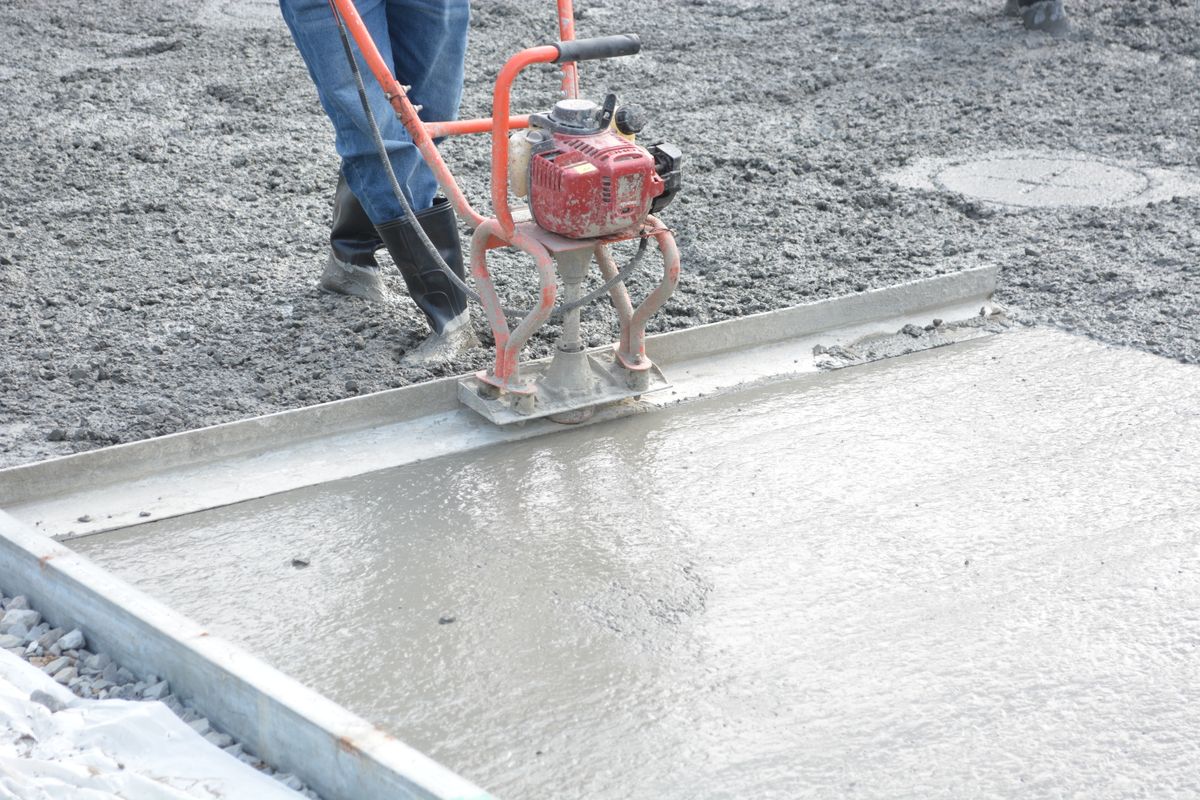
Concreter running a power screed across a freshly poured concrete slab in formwork

Membrane, steel and the pour

For most slabs a vapour barrier goes down over the base to keep ground moisture from rising up through the concrete. Reinforcement, mesh or bars sized to the slab and the load, is set on bar chairs so it sits inside the concrete rather than on the ground where it does nothing. On Bendigo's reactive clay the steel and the articulation are what let a slab cope with seasonal ground movement without cracking through. Then the concrete is placed, screeded level, and finished. A shed or garage slab is usually given a broomed or trowelled finish. A slab that is going to be a polished floor later is finished with that in mind, so tell your concreter early if that is the plan.

Control joints are cut or set into larger slabs so any shrinkage cracking is directed to a neat line rather than showing up across the middle. Then the slab is cured properly. On a hot, dry Bendigo summer day that means keeping moisture in the concrete rather than letting it flash off in the heat, because that is what builds the strength. In winter the cold slows the set right down and a concreter will not pour into a frost, so timing is planned around the weather at both ends of the year.

Slabs We Quote On, and What to Check

Common slab jobs across Bendigo include:

A few things are worth sorting early. Habitable slabs such as a granny flat almost always need an engineer's design and council or certifier approval, and the slab type is matched to the soil classification of your block, which is where Bendigo's reactive clay really shows up. If you are pouring a slab you intend to polish later, decide that now. And if services run under it, get the plumbing and conduit set before the pour, because chasing them in afterwards is expensive.

Every slab needs a look at the block before it can be priced, because the ground, the access and the falls all change the job. Call us and we will get a local concreter out.

📞 Call for a slab quote

Related Concreting

Driveways

The same prep principles, scaled up for vehicle loads. Concrete driveways.

Polished Floors

Pouring a slab to polish? Start it right. Polished concrete.

Resurfacing

Renewing an old slab instead of pouring new. Resurfacing.

Local crews

Slab work across Bendigo, including Huntly, Kangaroo Flat and Epsom.

Concrete Slab FAQs

How thick should a concrete slab be?

It depends on what the slab is for and the ground it sits on. A shed or garage floor and a habitable granny flat slab are different builds, and reactive clay or disturbed mining ground can call for a stiffer design than a stable block. Thickness works together with the base and the steel, so a concreter or engineer sets it after looking at your block and the load, not off a fixed number.

Do I need council approval for a slab?

It depends on what the slab is for. A slab for a habitable structure like a granny flat or an extension generally needs an engineer's design and council or certifier approval. A small shed or a simple garden slab may not, depending on size and where it sits. Your concreter and certifier will tell you where you stand for your specific job.

Does Bendigo's reactive clay change the slab?

Very much. Reactive clay swells and shrinks with the seasons, so a slab needs correct steel, sensible articulation and good drainage to cope with the movement without cracking. Gravelly ironbark-forest ground around the fringes behaves differently again. The slab is matched to the soil classification of your block, which is why a site visit matters.

Does old mining ground affect a slab?

It can. On low-lying blocks in the older northern suburbs like Long Gully, California Gully and Ironbark, the ground may include old workings and disturbed fill that settles unevenly. A concreter who works those areas will check the ground and build the base to suit before pouring, and for a habitable slab an engineer's soil assessment covers it off.

Can I run plumbing under the slab?

Yes, and it needs to be done before the pour. Any drainage, water lines or conduit that run under a slab are set and inspected while the base is still open, because chasing services into a finished slab is costly and messy. Tell your concreter about services early so they are cast in from the start.

📞 Call Now Get a Quote